
Industrial Cold Saws for Steel Cutting in Australia
A metal cold saw is the most accurate way to cut steel, aluminium and tube with a clean, burr-free finish. Power Machinery supplies industrial cold saws for workshops and high-volume production across Australia.
- Superior surface finish vs bandsaws
- High accuracy for repeat production
- Reduced burr and rework
- Australian in-house service and support
Trusted Australian Supplier
Supplying industrial metal cold saws across Australia to fabrication, manufacturing and engineering workshops.
Industrial Grade Global Brands
Premium metal cold saws from our Partner, leading European manufacturer, MEP Saws.
Installation and Technical Support
In-house service department with full installation, commissioning and operator training available Australia-wide.
Finance & Flexible Purchasing
Finance options available to help workshops invest in the right metal cutting equipment for your needs.
Nationwide Delivery
Metal cold saws delivered and supported across Sydney, Melbourne, Brisbane, Perth, Adelaide and regional Australia.
What is a Metal Cold Saw?
A metal cold saw is a circular metal cutting machine that uses a toothed blade to cut steel, aluminium and other metals with high precision. Unlike abrasive saws, a cold saw produces a clean, burr-free finish with minimal heat, making it ideal for fabrication, manufacturing and production environments.
- Cleaner, burr-free finishes
- Minimal heat distortion
- High dimensional accuracy
- Reduced secondary processing
- Steel fabrication
- Manufacturing and engineering workshops
- Tube, pipe and extrusion cutting
- Production environments requiring repeatable accuracy
Common Cold Saw Applications
- Steel tube and pipe cutting
- Structural steel fabrication
- Aluminium extrusion cutting
- Production cutting of bar and sections
- Manufacturing and engineering workshops
Why Choose a Cold Saw Instead of a Bandsaw?
| FEATURE | COLD SAW | BANDSAW |
|---|---|---|
| Cut Finish | Smooth, near machined | Rougher finish |
| Burr | Minimal | Moderate |
| Accuracy | High | Moderate |
| Speed (Single Cuts) | Faster | Slower |
| Production Work | Excellent | Moderate |
| Blade Life | Long (can resharpen) | Shorter |
For businesses cutting steel tube, bar or extrusion to tight tolerances, a steel cutting cold saw delivers significantly better results than a bandsaw. It is the preferred solution for applications where cut quality, repeatability and production efficiency are critical.
Types of Cold Saws
Manual Cold Saws
- Operator-controlled cutting
- Ideal for workshops and low-volume work
- Cost-effective entry point
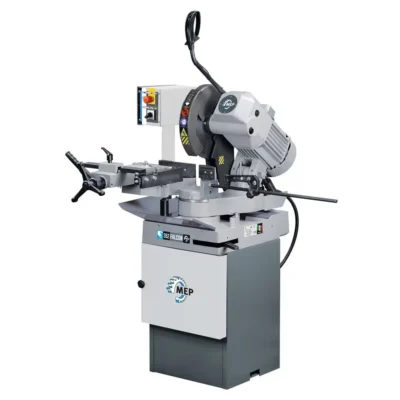
- Our models include MEP Falcon 352MA and MEP Tiger 352MA
Semi-Automatic Cold Saws
- Hydraulic vice and blade feed
- Improved consistency and safety
- Suitable for medium production
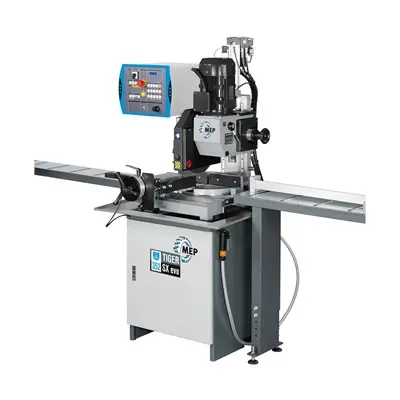
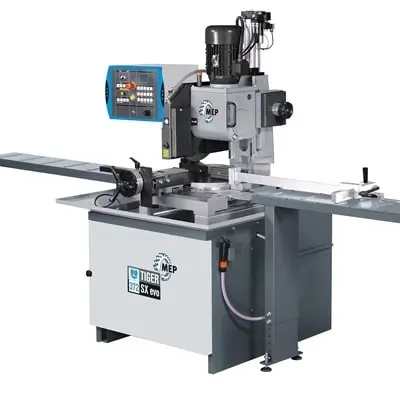
- Our models include MEP Tiger 352SX and MEP Tiger 372SX
Automatic / CNC Cold Saws
- Fully automated cutting cycles
- Programmable lengths and batch cutting
- Ideal for high-volume production environments
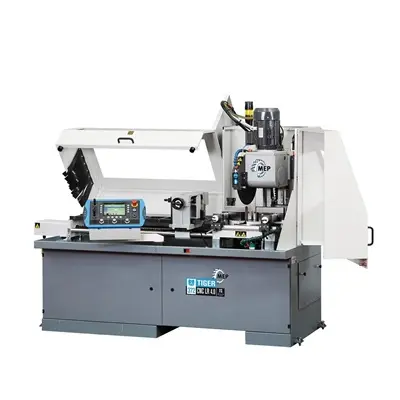
- Our range includes MEP Tiger 352NC and MEP Tiger 372 CNC LR
Contact us for specification, pricing and availability
MEP Cold Saw Range
MEP cold saws are widely regarded as one of the most reliable and precise cold saw brands globally, designed for continuous operation in demanding fabrication environments.


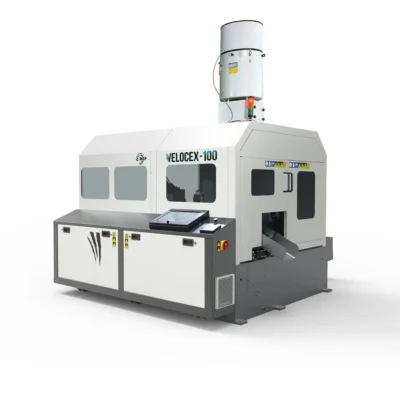
High Speed Saws for Maximum Production
- Best for mass production
- Extremely fast cycle times
- Tight length tolerances
- Ideal for automated production lines
How to Choose the Right Cold Saw
When selecting an industrial cold saw machine, consider:
- Material type (steel, stainless, aluminium)
- Maximum cutting capacity (diameter or section size)
- Volume of production
- Required tolerance and finish
- Automation requirements
Which is the Best Cold Saw for Your Workshop?
Three things decide it: how much you cut, whether the work repeats, and how much of an operator’s day you want tied to the saw.
| Manual | Semi-Automatic | Automatic | |
|---|---|---|---|
| Models in our Range | MEP Falcon 352MA & MEP Tiger 352MA | MEP Tiger 352SX & MEP Tiger 372SX Evo | MEP Tiger 352NC 5.0 & MEP Tiger 372 CNC LR 4.0 |
| Blade Type | HSS | HSS | HSS |
| Operator Involvement | Full - operator controls the cut | Loads and positions; machine clamps and cuts | Loads the bar; machine does the rest |
| Production Volume | Low - occasional cuts throughout the day | Medium - steady daily production | High - repetitive batch runs |
| Batch Programming | No | No | Yes - different lengths and quantities on one bar |
| Best For | Low volume, varied work, maintenance | Daily production with mixed jobs | Repetitive batch cutting |
| Investment | Lowest - starting from $8,900.00 plus GST | Mid Range - starting from $24,000.00 plus GST | Higher - starting from $53,056.00 plus GST |
Prices correct as at September 2026, excluding GST.
Best Cold Saw for General Fabrication
For most Australian fabrication workshops, a semi-automatic cold saw in the 300–370mm blade range hits the best balance of cost, performance and productivity.
The machine handles clamping and the cutting cycle while the operator positions material between cuts. You get repeatable cut quality without paying for automation you’d only use occasionally. The Tiger 352SX Evo suits most workshops; the Tiger 372SX Evo steps up for heavier or more continuous work.
Best Automatic Cold Saw for Repetitive Production
Once you’re cutting the same part in quantity, automatic is where the return appears and it comes from operator time, not cutting speed.
An automatic saw doesn’t cut faster than a semi-automatic of the same capacity. What changes is that nobody stands at it. The Tiger 352NC 5.0 and Tiger 372 CNC LR 4.0 feed by ballscrew and stepper motor, and you can programme different lengths and batch quantities on a single bar. Load it, start the cycle, and go and do something else.
The economics turn on part length. Cutting short parts from a long bar gives you a long unattended run; cutting 3-metre lengths means an operator returns after a couple of cuts. Work out your typical part length before deciding.
Best Cold Saw for Very High Volume
Where throughput is the whole game, a high speed carbide saw changes the calculation. Carbide-tipped blades running at higher RPM cut dramatically faster than HSS, and on high enough volumes the cost per cut drops below anything an HSS machine can reach.
The trade-off is blade cost and a narrower material range. It earns its place in continuous production, not general fabrication.
Best Cold Saw for Small Workshops and Maintenance
A manual cold saw remains the right answer for low-volume, varied work. Two options cover it: the Falcon 352MA, a pivoting machine with a heavy pedestal base cutting 45° left to 45° right, and the Tiger 352MA, a vertical model for workshops that prefer that cutting action.
Either way you keep cold saw finish quality and mitre accuracy without paying for automation that would sit idle.
Cold Saw FAQs
A cold saw is used for precision cutting of metal, including steel, stainless steel, aluminium and tube. It is commonly used in fabrication, manufacturing and engineering workshops where a clean, burr-free finish and high dimensional accuracy are required. Cold saws are ideal for cutting bar, pipe and extrusion to tight tolerances with minimal need for secondary processing.
A cold saw is named for its ability to cut metal with minimal heat generation. Unlike abrasive or friction saws, a cold saw uses a toothed circular blade that removes material efficiently, keeping both the blade and workpiece relatively cool. This results in reduced heat distortion, improved cut quality and longer blade life.
Cold saws are generally better than bandsaws when cut quality, accuracy and repeatability are important. They produce a smoother, near-machined finish with minimal burr, making them ideal for production work and precision fabrication. However, bandsaws are more versatile and lower cost, making them suitable for general-purpose cutting where finish is less critical.
Cold saws use circular metal cutting blades, typically made from high-speed steel (HSS) or carbide-tipped materials. HSS blades are commonly used for steel and can be resharpened multiple times, while carbide blades are used in high-speed saws for increased productivity. The correct blade selection depends on the material, cutting speed and required finish.
Yes. Cold saws cut mild steel, stainless steel, aluminium and most non-ferrous metals when matched with the correct blade and cutting parameters. Blade selection, feed rate and coolant all change with the material — stainless needs a slower feed than mild steel, aluminium needs a different tooth form. Cold saws are widely used for cutting steel tube, bar and sections in fabrication workshops.
The main difference is the blade and the cutting speed. A cold saw uses a high-speed steel (HSS) blade turning at low RPM with coolant, producing a clean, accurate, burr-free cut across a wide range of materials. A high speed saw uses a carbide-tipped blade at much higher RPM, cutting significantly faster and delivering a lower cost per cut once volumes are high enough. Cold saws suit general fabrication and mixed work; high speed saws suit mass production and automated lines where throughput is the priority.
Yes, most cold saws use a coolant system to reduce heat, extend blade life and improve cut quality. Coolant helps lubricate the cutting process, minimise friction and prevent overheating, particularly when cutting harder materials like stainless steel. Proper coolant use is essential for achieving consistent, high-quality cuts.
Call (02) 8445 8555
Request a Quote
Australia-wide delivery and support
Cold saws are also known as metal cold saws, circular cold saws, steel cutting cold saws and industrial cold saw machines.
We also sell quality metal bandsaws and aluminium saws.